
Chapter 2 - Mom & Dad Make Me - Lois Vesta (Dealy) Johnson (My Mom) & Tom Lloyd Johnson Jr. (My Dad)

By Doris Jean Dealy (Her Sister)


Lois was born on June 10, 1922, in Houston, Texas, the first daughter of James Baker Dealy, 23, and Olgia Vesta Boettcher, 26. Lois was the first grandchild in the J. V. Dealy family, named after her aunt, her father’s sister, Lois Dealy, and “Vesta” from her mother. Her father owned a drugstore that Elnora Boettcher had given him, and her mother worked part-time there. They lived in a beautiful new house at 539 Merrill Street, also a wedding gift from Elnora Boettcher.
During the day, while her parents were at work, Roberta, a Black housemaid, cared for Lois. As a young child, Lois struggled with bedwetting and was punished by her father, who paraded her down to the family’s drugstore dressed only in diapers to embarrass her. She was always disciplined and spanked with her father’s razor strap, which hung on the bathroom door. Her father mixed his shaving cream in a mug and shaved with a straight razor every morning.
Lois

As a teenager, she remained very active in church, at social events, and in the choir, where she performed solos. In 1938, she also served as Queen of the church’s Mayfest.
Her childhood was joyful. She enjoyed typical girlhood interests like dolls and pretty clothes. She loved her father and his family. She was less fond of her mother, but she cared for her grandmother, Elnora, and her great-uncle Edward. She attended Travis Elementary, Hogg Junior High, and Regan Senior High Schools. She was an average student, but found languages and history difficult. Math was her best subject. She loved music and took piano lessons. As a child, she visited the Boettchers in Westfield, and as a teenager, she visited them in Huntsville. She was close in age to Ed Jr., and they were good friends. She participated in Girl Scouts and went to summer camp at Camp Tejas on Clear Lake. She was not interested in sports or camping. Lois was afraid of water and never learned to swim. Her younger sister was born when she was 8, which changed her life. Her father sold or lost the drugstore and lived a more normal, manageable life for the next five years. Her sister Jean was sick for the first three years of her life, and her mother made her care for the sick baby. Only when Lois became a teenager and her sister’s health improved did her mother start acting like a mother again.
As a teenager, Lois was beautiful. She loved the boys, and the boys loved her. Like her father, she was very outgoing. She enjoyed being around people, attending parties, singing, and dancing. Her best friends were Evelyn O’Leary, Betty, Francis, Stacy, and Beverly Evert. She and her friends joined the Regan Red Coats marching squad in ninth grade. Her studies, which she had to work hard to complete, were a challenge because she preferred an active social life. In tenth grade, Lois and Beverly were reported, along with some boys, for being off the school grounds during classes; as a result, Lois was suspended from school and the Red Coats. Beverly was allowed to stay in the Red Coats. This was a severe emotional blow to Lois. Her interest in school dropped sharply, as did her grades. She had to attend summer school at San Jacinto High School the following summer.
Lois met a new group of male admirers during San Jacinto High School’s summer session. She then started dating San Jacinto, a football player. Her heart was set on a top-rated player, Bob Jackson, who was very popular with the girls and shared Lois’s passion for socializing; she adored him. Another player was a young man named Tom Johnson, her future husband.
Lois’s mother thought she was very fickle when it came to her male friends. One day, Lois canceled a last-minute date with an old admirer, approved by her mother, to go out with her heartthrob, Bob Jackson. Her mother met Bob at the door, told him Lois wasn’t going out with him, and explained why. Lois had a fit that lasted days; her mother banned her from dating for two weeks.
Other scenes showing Lois’s constant crushes and dates only deepened her resentment toward her mother. Additionally, her father's neglect of these episodes and his secret support for Lois made her care even less about her mother and her opinions. She had to be home by midnight and always go on double dates; however, she often broke these rules.
Her mother waited for Lois whenever she went on a date, always there to ensure she returned safely. One Saturday night, Lois did not come back. At 1:30 a.m., her mother received a phone call saying there had been a serious car accident near Galveston, and Lois was involved but unharmed. Hours later, Lois arrived home; by then, both parents were awake and pacing. Lois was scared and hysterical. She had swapped dates with a friend, which meant riding in the second car. As they approached the drawbridge entering Galveston Island, the front vehicle (first car) crashed head-on into the raised drawbridge; the car Lois was supposed to be in, and all the passengers, were killed. That event made Lois more cautious; she listened to her mother’s advice and to her concerns about her future safety.
In her senior year, she began dating George Huffman, a football player at San Jacinto High School. She became very emotionally and romantically involved with him. They frequently double-dated with George’s close friend, Tom Johnson, and his date. They did go steady and attended their high school proms together.
After finishing high school, Lois’s family expected her to go to college, but she disliked school and chose not to apply. That summer, she worked in her father’s office at his drug store. In the fall of 1939, she started business school and focused on bookkeeping and accounting. English was her weak spot. That fall, her boyfriend, George Huffman, went to college at LSU on a football scholarship. Lois and George maintained a close, long-distance relationship for a year. George began dating other LSU girls, and Lois and George's affection started to fade.
World War II began on September 1, 1939, when Germany, led by Adolf Hitler, invaded Poland. This act of aggression prompted France and the United Kingdom to declare war on Germany two days later, on September 3, 1939.
I am 80; the final step to living up to the words of our Constitution started before I was born. The “Our Gang,” or later “Little Rascals,” from 1930 to 1940 dominated my parents’ childhood and helped fix America. See comments at the end.

My parents graduated from high school in Houston, Texas, around the same time, in 1939-1940: My dad attended San Jacinto High School, and my mother attended Reagan High School. My mother had beautiful brown eyes, and my father had gorgeous blue eyes. They were considering college or a career.
In the summer of 1940, Tom L. Johnson Jr. began dating Lois. He lived with his mother and attended Rice University, where he tried to major in engineering while playing football. He found it too difficult to do both, and he didn’t want his mother to pay for his education. After one year, he dropped out of classes and football to work as a teller at The National Bank of Commerce. Lois had finished her business courses and was working when she and Tom began dating seriously.
With two salaries helping pay their mortgage, Tom and his mother could afford a new house in West University Place, within walking distance of the Simmons, Tom’s mother’s sister’s family. By then, Tom and Lois had fallen in love; they both wanted to marry. Tom asked Lois to marry him, and they became engaged in early 1941. Since Lois was under 21, she needed her parents' approval. Her father consented, but her mother did not. Tom and Lois confronted her parents at a meeting attended by Elnora Boettcher, who specialized in family decision-making. A long, bitter discussion followed, during which Lois was accused of being pregnant and Tom was told he lacked the means to support a family. He was also told he didn’t have the character or status to be Lois’s equal; he needed to prove himself before he could be considered for family acceptance. Lois’s father, who disliked his mother-in-law, defended the couple; after a heated argument, the mother and grandmother backed down and agreed to let Tom and Lois get engaged to see if they could make it work. Thus, Lois, who was in love with the idea of love and eager to leave home, was finally engaged. However, her sister still thinks she prefers George Huffman. Secretly, the mother and grandmother hatched a scheme to create distance between Tom and Lois—a rare vacation planned for the summer of 1941, likely funded by Elnora Boettcher. Despite her wishes, Lois traveled with her family on the only real vacation they ever took, visiting San Antonio, Kerrville, and Lake Buchanan. On October 25, 1941, Lois and Tom married at St. Mark’s Methodist Church in Houston. After a weeklong honeymoon in Galveston, they moved into a home at 3925 Melton Street to start their life together with Tom’s mother. This was a difficult time for Lois; it felt like jumping from the frying pan into the fire. She found Mrs. Johnson hard to get along with because she was selfish, jealous, and demanding.
When Thanksgiving arrived, Lois had only been married for a month. As the new wife with no family traditions to follow, she took charge of the cooking. Marie, who loved to eat, insisted on buying a goose for the celebration. Lois, 19, had never cooked such a meal before. She probably shouldn’t have taken on this task; she had three older, more experienced women trying to outdo each other as master chefs. When dinner was finally served, her father was drunk, and her husband felt nervous and embarrassed as he carved his first bird, a goose, while his wife and in-laws watched. The goose was very greasy, and the vegetables were barely warm, but Elnora broke the tension by claiming her favorite part of the bird—the parson’s nose, the part that went over the fence last, the Goose Butt. To those who didn’t know her, this was shocking.
Two Sundays later, on December 7, 1941, Lois and Tom went to Huntsville with her parents and sister to visit her mother’s family, the Boettchers. During the afternoon family discussion, news of Pearl Harbor and the war with Japan was announced. Soon afterward, Tom joined the Air Force. It was a sad day when Tom left Union Station, with everyone crying as he headed off for basic training. Lois continued to live in her new home on Melton Street with Tom’s mother, but she felt some emotional relief when Ed Boettcher’s new wife, Lucille, came to stay with Lois while Ed and Tom were in basic training.

After basic training, Tom was sent to Santa Anna, California, for pilot training, and Lois moved there to join him. The flight instructors flunked Tom as a pilot candidate because he was more curious about how the plane worked than about learning to fight and fly in battle; he lacked the “just do it” attitude. When he failed to become a pilot, he was reassigned to McCook, Nebraska, where he trained as a mechanic on the new, large B-29. Lois joined him there and stayed until July 1944, when she returned to Houston, six months pregnant, to live with her parents.
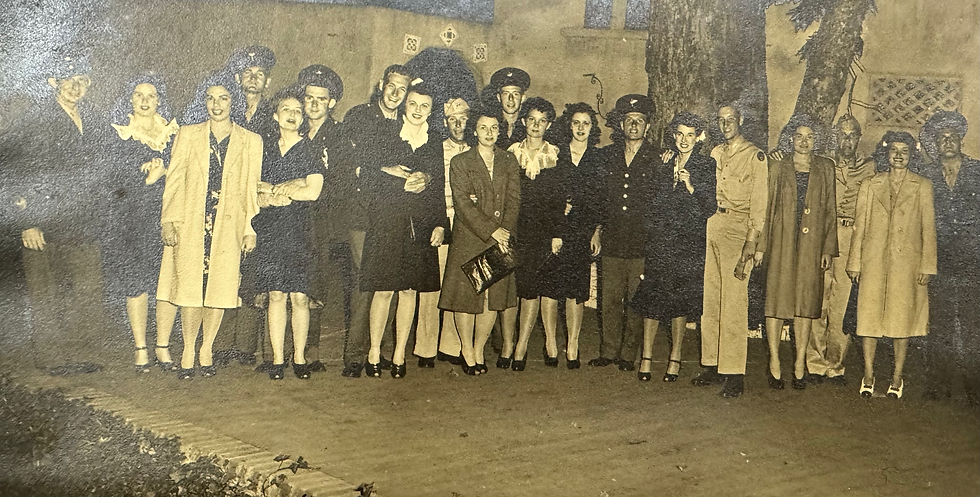
Her parents were thrilled to have her back and remodeled the front bedroom for Lois and the baby. She went into labor on the evening of October 30, 1944. Her parents took her to the hospital immediately.
At 2:30 AM on October 31, 1944, her first child, Tom L. Johnson III, was born. Tom received an emergency 48-hour leave to fly home and see his new son. A steady stream of military transport planes flew back and forth between the Mariana Islands in the South Pacific and points across the United States. He was then sent back to the South Pacific. Mother and baby were both well and returned home to wait out the war's end.

Baby Tom was quickly nicknamed “Spooky” by his grandfather and spoiled rotten by his grandparents and his 13-year-old aunt. Shortly after Spooky’s first birthday, his dad returned home; the war was over. The family moved to 3925 Melton Street, this time without Grandmother Johnson.
My Father’s Early Life
After my father's parents divorced, he grew up without a father figure. His mother’s father worked for the Southern Pacific Railroad as a blacksmith in Stephenville, Texas. As a result, Marie (Tom’s mom) got a job at the Southern Pacific office in downtown Houston, Texas. With good pay and almost free travel on the Southern Pacific Railroad, Tom and his mother enjoyed an educational, middle-class life while traveling across the US.
Tom, my dad, was a bright child with a messy room who needed discipline. According to Marie Johnson, as a teenager, he dated girls, changed his clothes several times a day, and threw the “dirty” clothes on the floor. Marie and Tom kept her ex-husband's last name and never remarried. She was a strong, hard-working woman who raised my father and supported his desire to develop a solid male character and earn good grades in school. He excelled in engineering math; he was a perfectionist who struggled with creativity and the written word.
He went to boot camp, where he found discipline, morals, and order that would stay with him for the rest of his life and strongly shaped how he conducted himself as a father, policeman, banker, councilman, and mayor. Beyond military discipline, my father immersed himself in Scottish Rite Freemasonry, which became a major source of the ideology that guided his life. He spent much less time in church than my mother did.
WWII Service & The Atomic Bomb
The runways for the B-29s on Tinian Island were quickly built, covering the sparkling white coral with black asphalt. It wasn’t until several B-29s crashed that Air Force engineers realized the mistake of landing planes on white coral, which, in the heat of the day, caused the planes to gain a lot of lift. Then the black paving caused the planes to lose lift and crash on the runway.

My father watched as his best friend and my mother’s first love, George Hufman, experienced a fatal crash due to this very reason.
The solution to the deadly runway issue was straightforward: change the bright coral color to a gradual transition from bright white to dark black, allowing the pilot time to adjust. My mother and father loved George, so they named their third son George.


Here
are historical photographs from 1945 showing the preparation and loading of the atomic bombs onto B-29 Superfortress bombers on Tinian Island in the Pacific, prior to the missions against Japan.
Little Boy (the uranium bomb dropped on Hiroshima by the Enola Gay):
Fat Man (the plutonium bomb dropped on Nagasaki by the Bockscar) being prepared and handled:


These images capture the ground crew operations as the bombs were positioned under the aircraft for loading into the bomb bay. The Bockscar (with its famous nose art) and the overall setup on Tinian were central to the final stages leading up to the flights.
These are authentic archival photos from the Manhattan Project.
in order to strategically end the war with the lowest casualties for both the Japanese and Americans.

(The Enola Gay on Tinian Island before/after the mission, often shown with the mushroom cloud in composite or illustrative views.)
Mushroom cloud over Hiroshima (photographed from observation aircraft): Hiroshima: August 6, 1945 (Little Boy bomb dropped by the B-29 Enola Gay at approximately 8:15 a.m. local time).
Nagasaki: August 9, 1945 (Fat Man bomb dropped by the B-29 Enola Gay at approximately 11:02 a.m. local time).
The war ended when the Japanese surrendered on September 2, 1945.
My father returned home sometime between my first birthday and Christmas of 1945. He went back to his teller job at the National Bank of Commerce in downtown Houston after leaving for World War II. We moved my mom and me out of her family’s home to 3925 Milton Street, West University Place, Texas. This was our family home till Spring of 1954. A place where my brothers, first Jimmy and then George, were conceived and born.
Comments